|
Missing Water: Report and Article Examine Water in
the Colorado River Delta
The Pacific Institute for Studies in Development, Environment,
and Security is pleased to announce the release of Missing
Water: The Uses and Flows of Water in the Colorado River Delta
Region. This new study describes the fate of the millions
of acre-feet of water diverted from the Colorado River at and
below Imperial Dam, and the total inflows to and outflows from
the Colorado River delta region more generally.
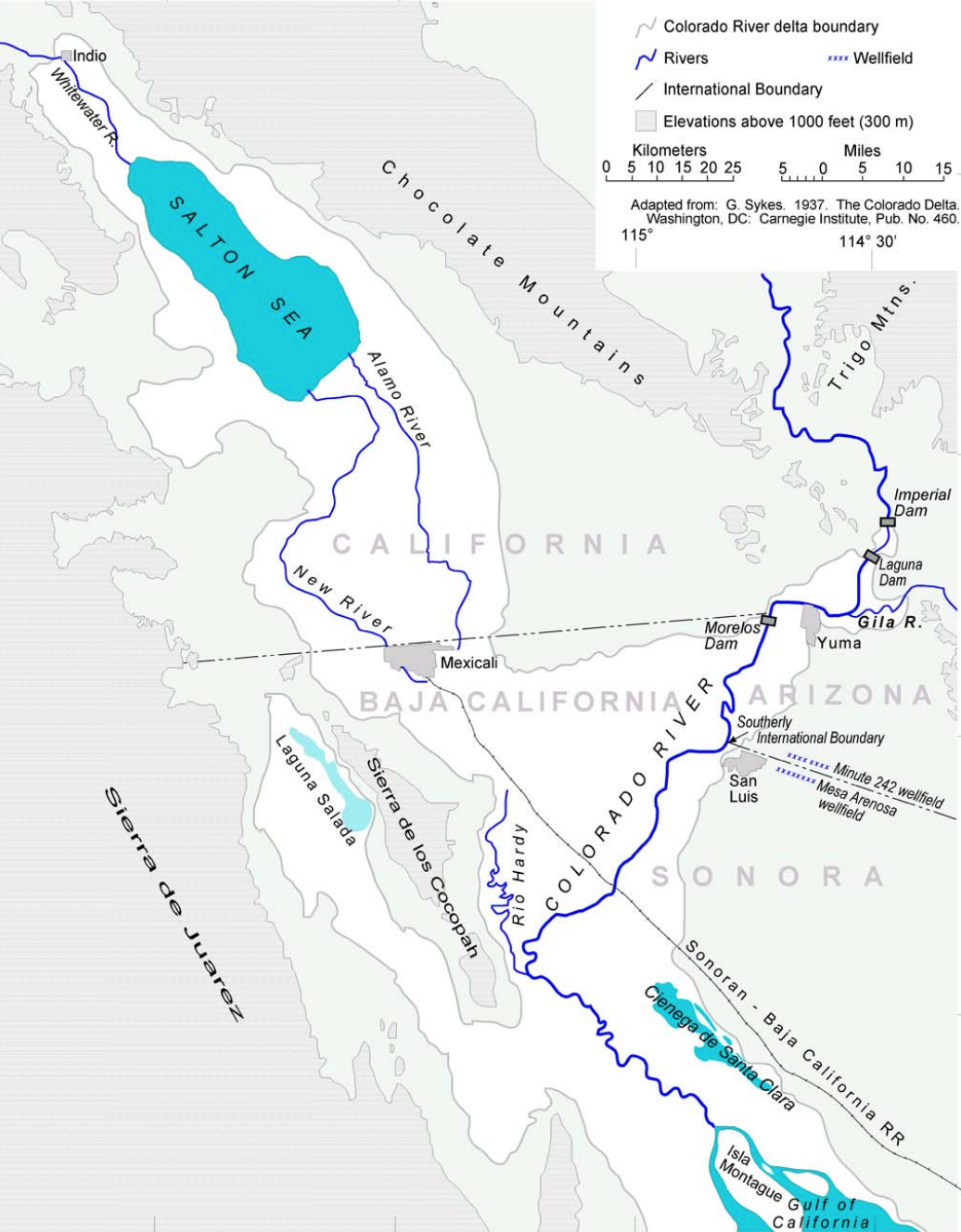
This study uses the classic hydrologic boundaries of the delta
region described by Godfrey Sykes in 1937, encompassing some 3,325
square miles (8,611 square kilometers) in the states of Arizona,
Baja California, California, and Sonora, including the Imperial,
Mexicali, and San Luis valleys, Yuma Project lands, and the lower
Coachella Valley. The study period examines the flows and uses
of water in the years 1991-1998, divided into Flood and Non-Flood
years to reflect the tremendous variability of mainstem Colorado
River flows.
Missing Water compiles flow data along the mainstem and along
diversions within the delta region, the first time such data has
been compiled for the region as a whole. The study also report
consumptive uses of water in the agricultural and urban sectors,
and estimates such use by the environment. Agricultural use is
also reported for the major crops in the region, both by acreage
and by water use.
More Detail on Remnant Delta in Mexico
Also available is an article published in the the Journal of
Arid Environments, which provides a more detailed analysis of
the flows of water within the remnant portion of the delta in
Mexico.
MJ
Cohen, C Henges-Jeck, and G Castillo-Moreno. 2001. A preliminary
water balance for the Colorado River delta, 1992-1998. Journal
of Arid Environments 49:35-48. (PDF)
The
Sustainable Use of Water in the Lower Colorado River Basin
(purchase this report)
|